✨ Add Bookmark
Filtering by:finance

Ultimate Steam Game Publishers List | IMPRESS
impress.games•10 TAGS
K
Kinshuk SunilFeb 11This text describes a Steam game publisher database designed to help developers find suitable publishers based on genre and performance metrics. The database offers tools for analyzing publisher performance and includes caveats regarding data accuracy. It's presented as a hobby project by IMPRESS, an indie game marketing toolkit company. IMPRESS offers a suite of tools for game marketing, including influencer monitoring, press kits, and analytics, with some free access options. The overall goal is to simplify indie game marketing and help developers succeed.

Blueberry AI - Efficient Digital Asset Management for Game, Industrial Design, and Retail
blueberry-ai.com•9 TAGS
Y
Yadu RajivApr 30Blueberry AI's Kiwi Engine provides a browser-based platform for managing 3D digital assets, eliminating the need for bulky software. Its AI-powered features, including search, tagging, and version control, boost efficiency by over 60% and reduce time spent on previews by 40%. The platform facilitates seamless collaboration among internal and external teams, improving workflow and productivity. It caters to various industries, including gaming, advertising, and industrial design, offering significant cost reductions and improved asset availability. A free consultation is available to assess individual needs and demonstrate the platform's capabilities.
🔗
GameAnalytics x Deconstructor of Fun Masterclass
gameanalytics.com•5 TAGS
Y
Yadu RajivDec 10Join GameAnalytics and Mishka Katkoff for a four-part masterclass on data strategy, acquisition, retention, and monetization. Designed to help you build, scale, and sustain successful games.
🔗
Reddit - The heart of the internet
reddit.com•8 TAGS
Y
Yadu RajivMay 5A Reddit user analyzed data from 5,773 AA and indie games released in 2024 that earned at least $500 on Steam. The analysis revealed that the top 10% of games account for the vast majority of revenue in both AA and indie categories. Median revenue was significantly higher for publisher-backed games ($16,222) compared to self-published ones ($3,285). High-performing genres included NSFW, simulation, and strategy, while puzzle and platformer genres had lower median revenue. The data is available in a Google Sheet for further exploration.
🔗
Sales and Marketing (Steamworks Documentation)
partner.steamgames.com•7 TAGS
S
Shubhank MauriaJun 13Steamworks provides tools and services for game developers to manage their games on Steam. It offers documentation covering setup, store presence, features, finance, sales & marketing, and SDK access. Resources include SteamVR, PC café programs, and community forums. News and updates are available through various blogs. Support is provided in multiple languages.

Asia and MENA games market generates $86.6bn in 2024 | GamesIndustry.biz
gamesindustry.biz•3 TAGS
K
Kinshuk SunilJun 13The Asia, Middle East, and North Africa (MENA) gaming market reached $86.6 billion in 2024, showing modest growth. Niko Partners' report highlights India as the fastest-growing market, projected to become a billion-dollar market by 2025. Southeast Asia and MENA also experienced significant growth, with Saudi Arabia and Thailand leading their respective regions. The overall market is expected to reach $96 billion by 2029, driven by increasing player numbers and diverse demographics. The report also notes a significant rise in female gamers in India and the MENA region.

“We need our studios to believe they can grow again” – Ukie
thegamebusiness.com•5 TAGS
K
Kinshuk SunilJun 29The UK games industry received a £30 million government boost, aiming to foster growth and address skills shortages. This support comes amidst a challenging period for British studios, impacted by Brexit and post-COVID market conditions. The Game Business Show discussed this news, interviewing Ukie CEO Nick Poole, who emphasized the need for a growth mindset within studios. June's game releases saw mixed results, with some titles like *Rematch* and *Dune Awakening* performing strongly, while others like *MindsEye* and *FBC: Firebreak* struggled. The show also covered other industry news, including the closure of Hypixel Studios and a class-action lawsuit against Sony.
Bramble Royale Steam Launch Retro - Slothwerks’s Substack
slothwerks.substack.com•7 TAGS
Y
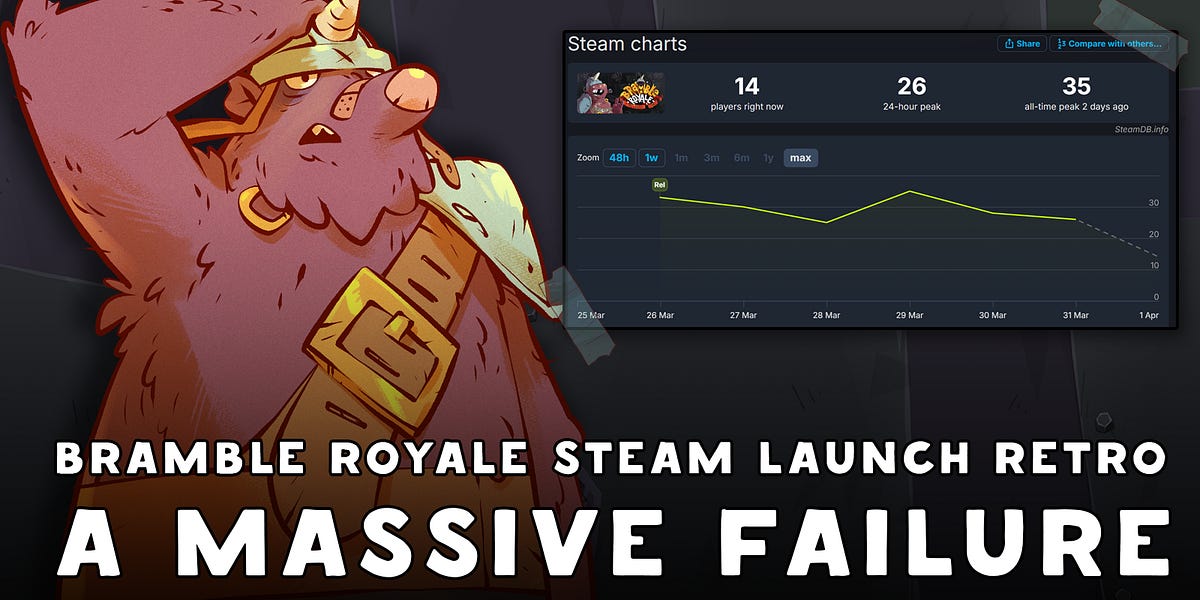
Yadu RajivMay 5Eric Farraro's Substack post details the disappointing Steam launch of his game, *Bramble Royale*, despite positive reviews. The game, a deckbuilder, underperformed significantly against sales projections, selling only 621 units in its first week. Farraro attributes the failure to market saturation in the deckbuilder genre, a lack of a strong marketing hook, and a lengthy development cycle. He reflects on the challenges of indie game development and plans to focus on a mobile port and future projects, learning from this experience. Despite the commercial setback, he remains proud of the game itself.

Seyed's Publisher List - Google Sheets
docs.google.com•8 TAGS
Y
Yadu RajivDec 19This document presents Seyed's Publisher List, a curated database of publishers funding premium PC/Console indie titles. It excludes publishers focused on AAA, F2P, or those not funding development. The list is not exhaustive and encourages community contributions to an open sheet, with data transferred quarterly to the curated sheet. The guide provides details on contacting publishers, understanding revenue and budget metrics, and publisher communication ratings. Users are advised to upgrade their browser as the current version is unsupported.

Why Co-Development Still Fails - by Alexander L. Fernandez
substack.com•7 TAGS
Y
Yadu RajivDec 26Co-development in the video game industry often fails due to leadership avoidance, weak systems, and misalignment, not external factors like geography. Key reasons for failure include spec creep stemming from unmade decisions, the false economy of prioritizing cheapness over quality, and treating partners as mere "hands" instead of leveraging their experience. Effective co-development requires robust infrastructure for real-time visibility and trust, and it must be led by experienced individuals with the authority to make critical decisions. Ultimately, successful co-development is about orchestration and earned trust, not just outsourcing tasks.
GameDiscoverCo: People are spending less on games on Steam
substack.com•5 TAGS
Y
Yadu RajivDec 18Analysis of Steam's top 50 games from February 2023 to October 2025 reveals a trend of people spending less on games. While average prices have remained relatively stable, the median price has dropped significantly by 20% for units sold and 14% for revenue. This decline is attributed to an increase in popular, lower-priced games in the $5-$15 range. The AA game segment, priced between $25-$60, faces increased competition from both AAA titles and inexpensive indie games. This shift suggests a changing consumer spending pattern on Steam.