Tag: #history
4 Bookmarks

Subversion Tech Demo (June 2010)
Chris Delay's talk at World of Love (June 2010) demonstrating how was going to be in their game in developement at the moment: Subversion. This game from the creators of UPLINK and DEFCON was expected to launch in 2011. After its cancellation, most of the developed technology was repurposed in the game Prison Architect (currently in development).

How RimWorld Was Made and Why it’s Not a Video Game
This video chronicles Tynan Sylvester's journey in creating RimWorld, detailing his transition from solo prototyping to a successful Kickstarter campaign by adhering to a strict "value per cost" development philosophy. It explores the game's core identity not as a traditional simulation but as a "story generator," designed around "elastic failure" and simple visuals that encourage players to co-author unique, emotional narratives. The retrospective concludes with RimWorld's massive success on Steam, highlighting its continued evolution through a thriving modding community and five major expansions that have cemented its legacy as a masterpiece of emergent storytelling.
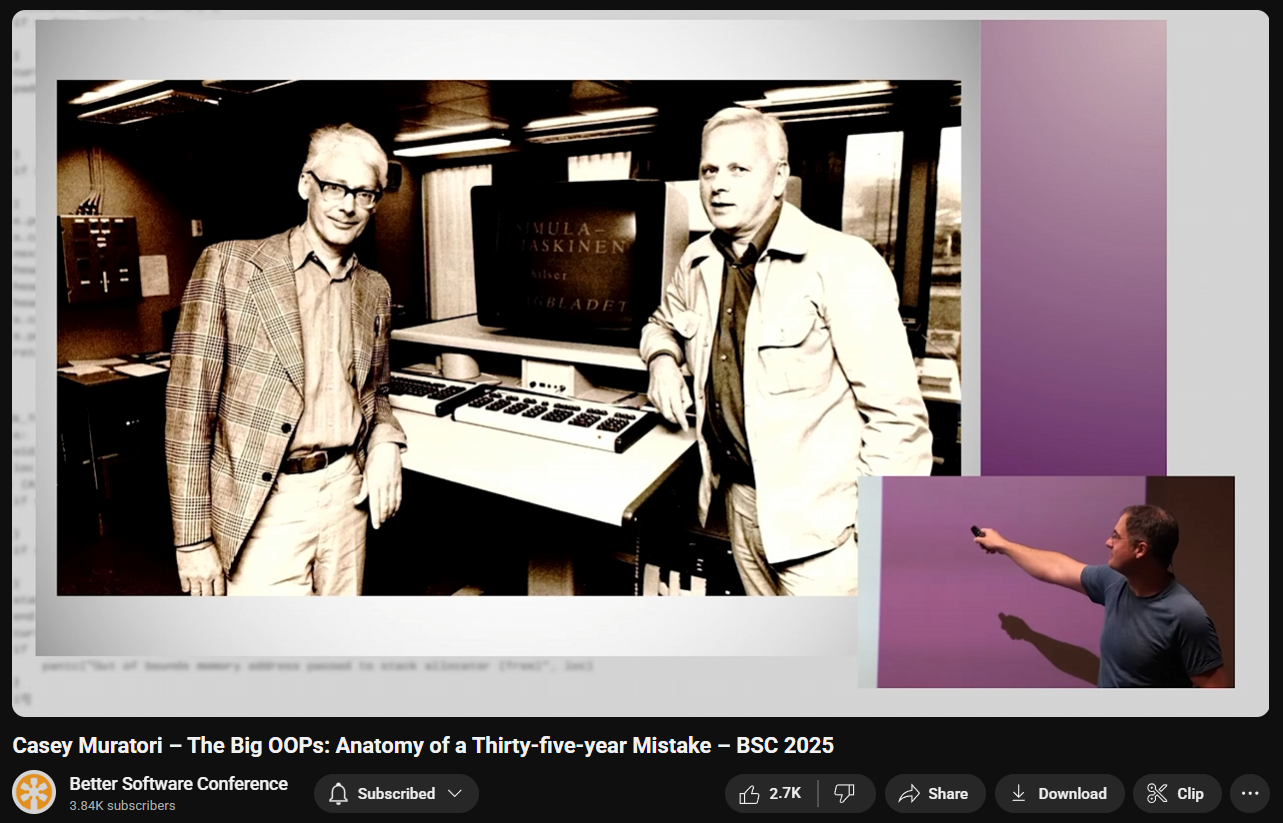
Casey Muratori – The Big OOPs: Anatomy of a Thirty-five-year Mistake – BSC 2025
Casey Muratori's talk at BSC 2025. Casey's links: https://ComputerEnhance.com/ https://x.com/cmuratori/ BSC links: https://BetterSoftwareConference.com/ https://x.com/BetterSoftwareC

Standard-gauge railway - Wikipedia
Standard gauge (1,435 mm or 4 ft 8 1/2 in) is the world's most common railway track gauge, used in about 55% of lines and almost all high-speed rail. Its prevalence stems from historical interoperability needs, avoiding costly reloading at gauge breaks. While its origin is debated, it likely evolved from existing wagonway gauges in England, influenced by the dimensions of horse-drawn carts. George Stephenson's adoption of this gauge for major lines solidified its dominance in Britain and beyond. Despite initial variations and a "gauge war" in Britain, standard gauge ultimately prevailed due to its efficiency and interconnectivity benefits.