Tag: #godot
6 Bookmarks

PROTO Game Asset Tools
Tools for game assets, improved export for Unreal, Unity, Godot
MinionsArt Tutorials
"MinionsArt Tutorials" offers a variety of tutorials for shaders/shadergraph
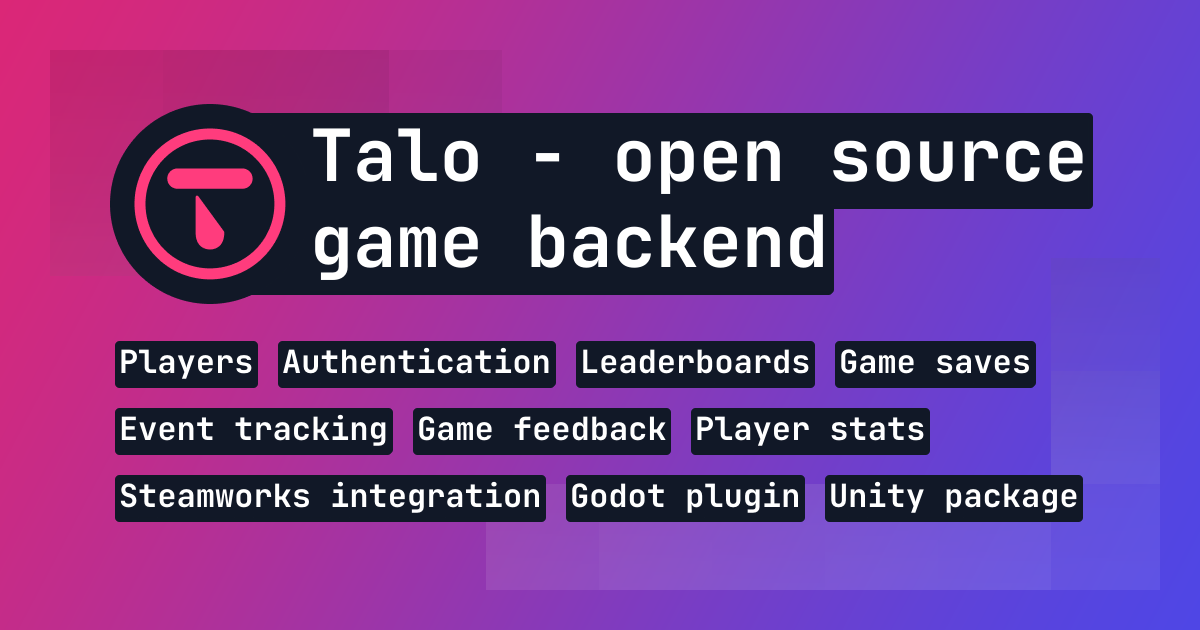
Talo - open source, self-hostable game backend
Talo is a free, open-source game backend service offering leaderboards, player authentication, multiplayer, and more. It integrates easily with Godot and Unity via plugins and an API, simplifying game development. Talo provides a dashboard for managing game data, player accounts, and feedback, along with robust analytics and Steamworks integration. The service handles hosting and infrastructure, ensuring data continuity even with network issues. Data export is available, and the platform is open for community contributions.

Our Workflow with Blender and Godot – Blog — Blender Studio
Blender Studio developed a pipeline for transferring assets between Blender and Godot using glTF, leveraging Blender's collection export feature. Custom code handled asset separation and data exchange, ensuring efficient collaboration among a team. The process involved automated export from Blender, including ID assignment and collision data, and automated import into Godot, recreating the asset hierarchy. Challenges included managing a central asset index and material duplication; future improvements aim for a more decentralized approach and potentially utilizing glTF extensions. The resulting workflow, while a prototype, is shared to encourage further development of Blender-Godot integration.
Nitrode: The Ultimate AI Game Engine
Nitrode is an AI-powered game engine that allows users to design, script, and deploy games within a single platform. It features an AI-assisted visual logic editor, enabling intuitive game mechanic creation. The engine generates assets (sprites, textures, scenes) using AI, eliminating the need for external tools. It also produces clean, editable code based on the user's design choices. Currently, Nitrode is available for MacOS only.
NobodyWho
NobodyWho is an open-source framework enabling local deployment of large language models (LLMs) without cloud infrastructure or scaling issues. It uses llama.cpp and offers a user-friendly interface for running LLMs, accelerating processing via GPU. Several example games built with NobodyWho are showcased, demonstrating its versatility. Troubleshooting sections address common issues like model file location after export and compatibility problems on specific Linux distributions (Arch, NixOS). The license allows commercial use but requires open-sourcing any modifications to the NobodyWho code itself.